Looking Back at the Transformation Workshop on Measuring Cluster Impact A fully booked Transformation Workshop of the Austrian National Cluster Platform in Linz demonstrated how openness, trust and collaborative learning can lead to new solutions at the national level – with the potential to inspire Europe.
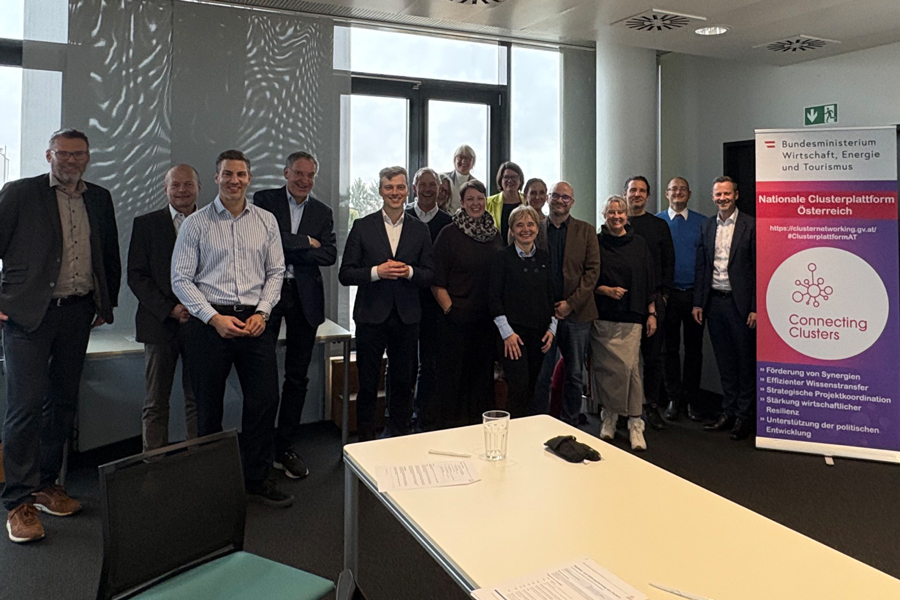
How can we better measure and demonstrate the impact of clusters? Which indicators are suitable for capturing not only activities and outputs, but also the actual added value that clusters generate for businesses, regions and the wider economy? And how can clusters strengthen their positioning in the context of the EU's next funding period?
These questions were at the heart of the fully booked Transformation Workshop of the Austrian National Cluster Platform, held on 17 November 2026 in Linz and hosted by Business Upper Austria. Alongside expert presentations and insights into different approaches to impact measurement, the workshop was characterised above all by a remarkably open exchange among Austrian cluster organisations and policy makers.
Measuring Cluster Impact Is Gaining Strategic Importance in the European Context
In his opening remarks, Stefan Buchinger, Coordinator of the Austrian National Cluster Platform at the Federal Ministry of Economy, Energy and Tourism (BMWET), emphasised that the discussion on cluster impact comes at a particularly important time.
With the next Multiannual Financial Framework (MFF) of the European Union on the horizon, and important decisions ahead regarding future EU funding priorities, it is becoming increasingly important to provide clear evidence of the contribution clusters make to economic development. In this context, impact measurement should go beyond traditional performance indicators. What matters is not only which activities clusters undertake and what immediate results they achieve, but also how they contribute to the development of the wider economy. The challenge lies in systematically demonstrating these diverse contributions and gaining a better understanding of their longer-term impact.
Different Approaches, a Shared Goal
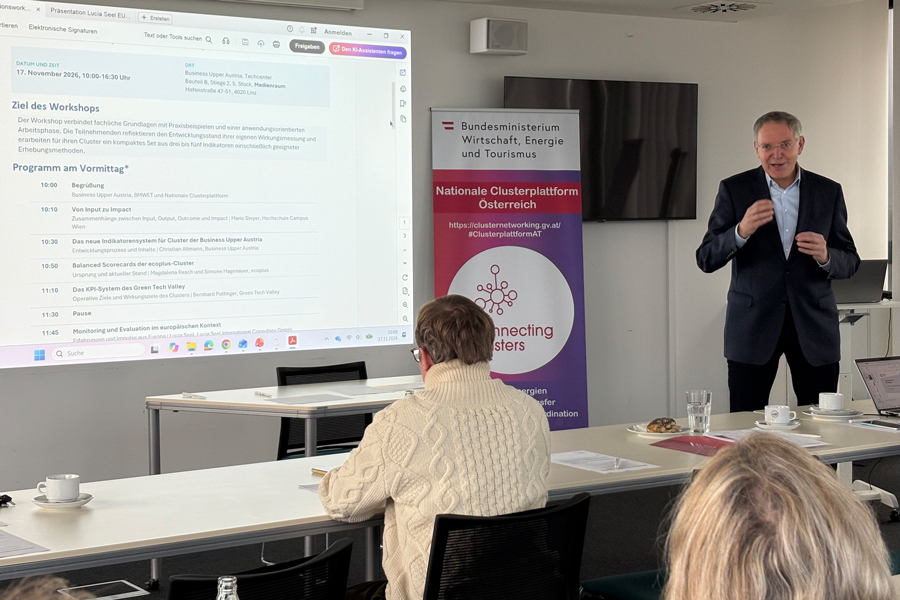
The morning's expert contributions highlighted the variety of approaches already being used by Austrian cluster organisations to monitor, evaluate and measure their impact.
Mario Steyer from Hochschule Campus Wien opened the discussion by exploring the relationships between input, output, outcome and impact. His presentation established a common framework for distinguishing between resources invested, services and outputs delivered, changes achieved and longer-term impacts.
Christian Altmann from Business Upper Austria then presented the newly developed indicator system for Upper Austrian clusters, offering insights into both its development process and its key components.
Magdalena Resch and Simone Hagenauer from ecoplus, the Business Agency of Lower Austria shared their experiences with the Balanced Scorecards used by Lower Austrian clusters. Meanwhile, Bernhard Puttinger from the Green Tech Valley Cluster explained how operational objectives and impact-oriented goals can be linked within a KPI system.
The European perspective was provided by Lucia Seel, who shared experiences and insights on monitoring and evaluation in the European cluster context
One thing became clear: while methods and framework conditions differ, many of the challenges are shared. How can meaningful indicators be defined? How can relevant data be collected without creating excessive administrative burdens? And how can the actual impact of cluster activities be demonstrated beyond short-term results?
From Diverse Experiences to a Joint Austrian Solution
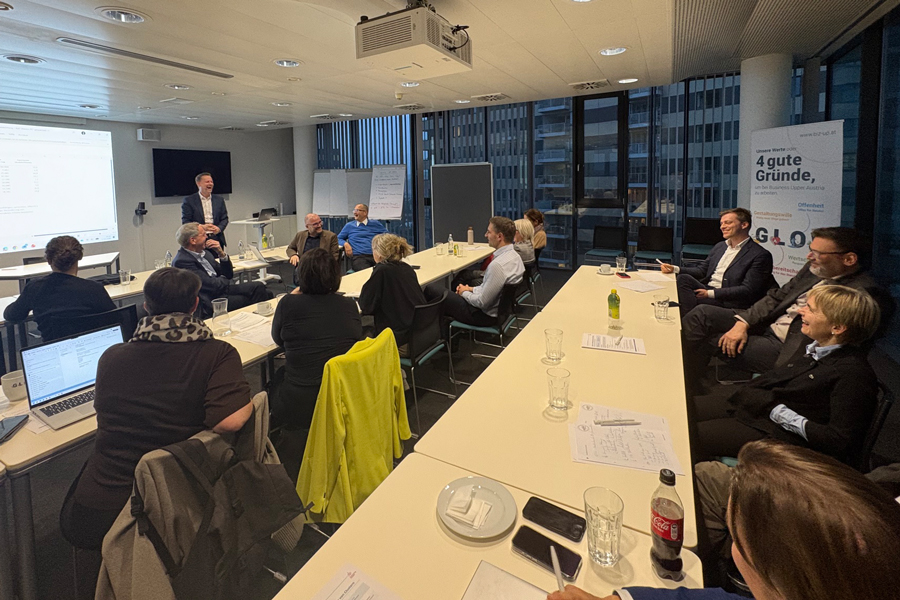
The afternoon focused on practical application. In small working groups, participants discussed the approaches presented and explored how they could be adapted to their own cluster management practices.
The real highlight of the workshop, however, was not any single methodology, but the collective outcome.
The remarkable openness with which participants shared their experiences, challenges and solutions across regional and organisational boundaries laid the foundation for an important step forward: Together, participants succeeded in developing a joint Austrian approach that could potentially serve as an inspiration at the European level.
This outcome demonstrates the considerable potential of trust-based dialogue within the cluster community. Different experiences and perspectives do not have to be obstacles to developing common solutions. On the contrary, they can become their most valuable foundation.
Openness and Trust as Key Success Factors
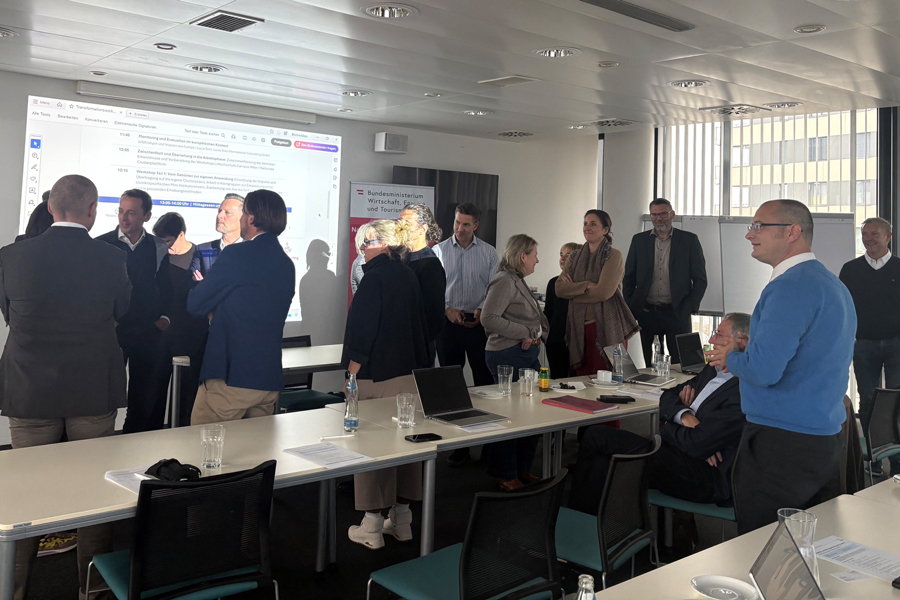
The workshop also highlighted the value of creating opportunities for direct and open professional exchange. Particularly when addressing strategic questions for which there are no simple or universally applicable answers, collaborative learning can generate new perspectives and lead to concrete solutions.
This also reinforced one of Stefan Buchinger's key messages: Open exchange formats like this can achieve far more than knowledge transfer alone. They build trust, foster shared understanding and create opportunities for new forms of collaboration.
The experience in Linz also underlined the important role of the Austrian National Cluster Platform as a forum for dialogue across Austria's federal states and for the joint development of the Austrian cluster ecosystem.
Special thanks go to Christian Altmann and Christoph Reiss-Schmidt from Business Upper Austria for their generous hospitality and excellent organisation of the workshop in Linz, as well as to all speakers and participants for their openness, engagement and willingness to learn from one another.
Our sincere thanks also go to Mario Steyer for his excellent moderation and facilitation of the collaborative development process, which made a significant contribution to the constructive discussions and the concrete outcome achieved.
The next opportunity to continue this dialogue is already scheduled:
On 1 March 2027, the Austrian National Cluster Platform will hold its next Transformation Workshop, once again in Linz. This time, the focus will be on the diverse applications of Artificial Intelligence (AI) in cluster management.
We look forward to continuing this open dialogue, learning from one another and jointly generating new ideas and momentum for the further development of Austria's cluster landscape.