Tourism Statistics System in Austria
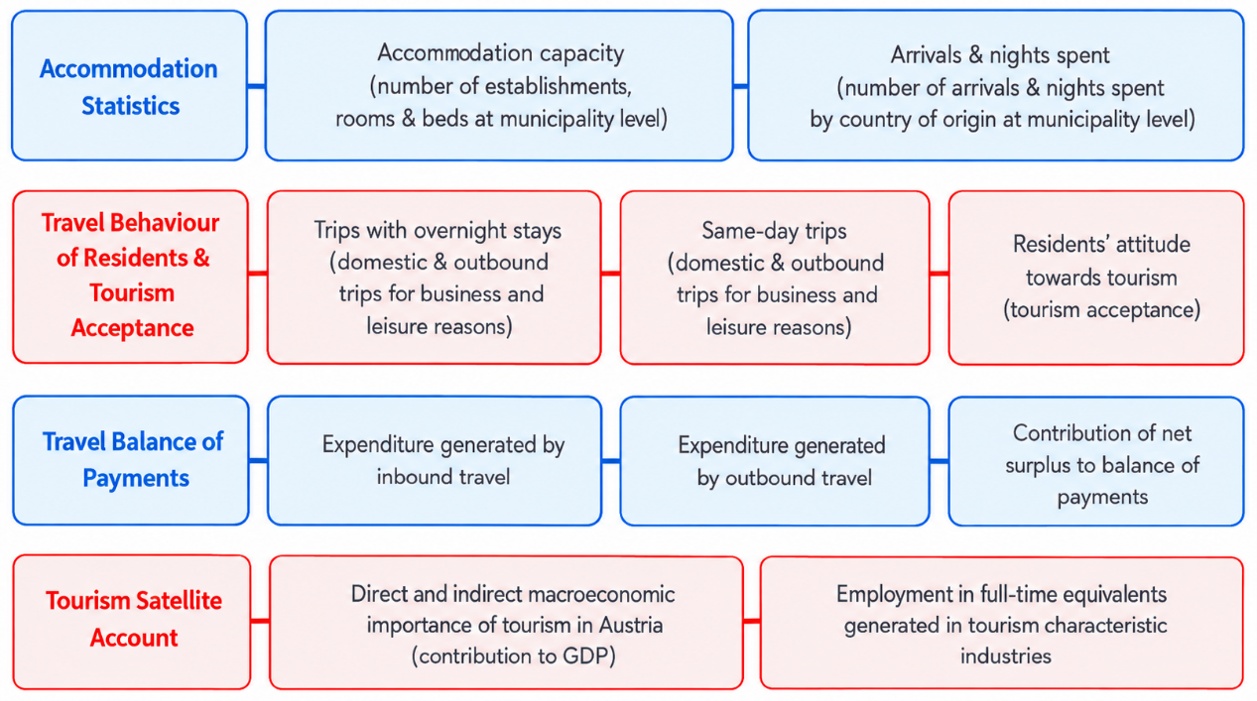
Statistics Austria (STAT), the Austrian statistical office, has been collecting tourism data for around 130 years. Its tourism and travel statistics cover four core areas: accommodation, travel behaviour, the travel balance of payments, and Tourism Satellite Accounts (TSA).

Accommodation statistics
The accommodation statistics provide key information about tourism in Austria, such as the number of nights spent and arrivals. Data is submitted monthly by around 73 000 commercial and private accommodation establishments via around 1 600 municipalities, broken down by type of accommodation and countries of origin. Furthermore, stock statistics (accommodation and beds) are collected once per year for the winter and summer season.
Travel Behaviour of Residents & Tourism Acceptance (TAS)
Every three months 3 500 representatively chosen individuals living in Austria (15-85 years old) are surveyed about their travel behaviour. The interviews are carried out by means of computer-assisted telephone interviews (CATI) and computer-assisted web interviews (CAWI). Participation in the survey is voluntary. The selection frame for the proportionally stratified sample is the “Central Population Register”.
Tourism acceptance in Austria was surveyed by an external market research institute as part of a pilot project from 2020 to 2023, which demonstrated the importance of measuring and continuously monitoring tourism acceptance in order to recognise trends and changes in the perception of tourism at an early stage and to react to them in a targeted manner. In 2024, the survey methodology was simplified and integrated into the existing Tourism Demand Statistics carried out by Statistics Austria, alongside the survey on the travel behaviour of the Austrian population. This integration legally secures the annual survey, ensures continuous monitoring of tourism acceptance, and allows significantly more people to be surveyed (13 000 interviews in 2025).
The new Tourism Acceptance Score (TAS), developed from the survey, shows the difference between positive and negative perceptions. In 2025, the key figure was clearly positive at +37 percentage points, with a positive TAS meaning the proportion of the population with a positive attitude outweighs that with a negative association. “Neutral” and “don’t know” responses are not taken into account in the calculation of the TAS, but are important when interpreting the TAS as they have a significant influence on the possible level of the TAS. The survey also asks for the importance of tourism for one’s own professional and financial situation, as well as the perceived volume of tourists at one’s own place of residence and for Austria as a whole. For example, 71% of respondents consider tourism to be very important for Austria’s economy, labour market, and leisure activities, while 48% indicated that there is the right number of tourists.
Travel Balance of Payment
On behalf of the Austrian Central Bank, Statistics Austria is responsible for collecting data about international payment flows in tourist travel. The travel balance of payments compares the expenditure of Austrian residents for travel abroad and receipts from incoming tourism (excluding international passenger transport). Austria generally has a positive net balance (2025: EUR 9.8 billion) with tourism being an important export product and contributing strongly to the country’s balance of payments.
Tourism Satellite Account (TSA)
Based on the recommendations of EUROSTAT, OECD and UN Tourism, the Tourism Satellite Account (TSA) was already implemented 25 years ago to allow the collection of data on the monetary scale of the tourism industry as well as an evaluation of the value created by tourism for the economy as a whole and the industry’s effect on employment. The TSA for Austria was set up in 2001 – starting with the reporting year 1999 – in the context of a collaborative project undertaken by the Austrian Institute for Economic Research (WIFO) and Statistics Austria. It is commissioned by the Federal Ministry of Economy, Energy and Tourism. The national tourism satellite accounts are drawn up annually; as of the reporting year 2003, the employment-related effects of the tourism industry are also considered. In view of the regional and local significance of tourism, regional tourism satellite accounts (RTSAs) for Vienna, Lower and Upper Austria as well as for Burgenland have been calculated for many years on behalf of the respective Federal state’s tourism organisation. By now RTSAs have been extended to all nine federal states.