Tourism Regulation and Coordination
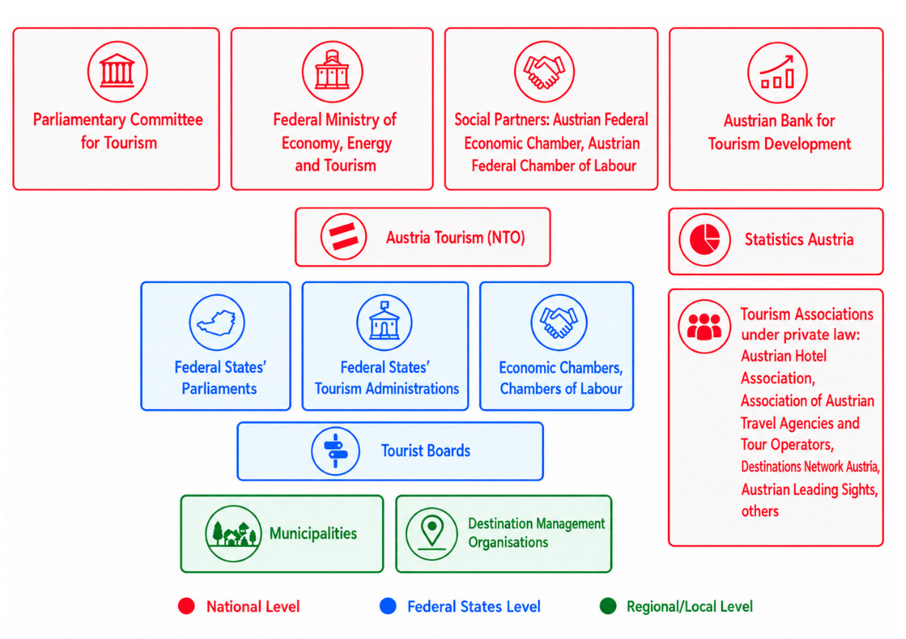
Tourism and leisure are cross-sectoral policy areas operating within a highly fragmented institutional environment involving multiple competent authorities. According to Article 15 of the Federal Constitutional Act (B-VG, General Clause), Austria’s nine federal states hold legislative and executive competencies for tourism and leisure affairs. The role of the federal government is to coordinate and streamline the overarching tourism policy. In addition, tourism-related affairs are addressed by a dedicated committee within the Austrian Parliament.
The Federal Government
The Federal Government is responsible for the affairs assigned to it under the Federal Constitutional Act. Tourism does not fall within these responsibilities. However, several federal ministries are responsible for legislation and policies that directly or indirectly affect tourism and leisure activities. These areas include transport, labour market policy, commercial law, climate policy, internal security, entry and exit formalities, public finances (taxes, fees), consumer protection, health and safety regulations, etc.
The Federal Ministry of Economy, Energy and Tourism coordinates the national tourism strategy, runs national funding programmes, and oversees national tourism marketing. It also addresses strategic tourism issues at both the national and international level. Synergies between the national and regional levels are strengthened through close political coordination, supported by a Steering Group for Tourism. Cooperation with other ministries, departments, institutions and stakeholders from the tourism industry is organised around specific topics through permanent working groups, workshop series, or round-table discussions (e.g. regarding communication, sustainable mobility, visas, cycle tourism), as well as on an ad hoc basis for issues such as funding schemes or tourism-related legislation.
The Ministry´s representation and active participation in international organisations such as United Nations World Tourism Organization (UN Tourism), the Organisation for Economic Co-operation and Development (OECD), and the European Union enable close cooperation with other countries on tourism-related issues, facilitate the exchange of knowledge and expertise, and provide valuable insights into current tourism developments in Europe and beyond. The Ministry also acts as an important link between tourism policy at the national, regional, and local level and the international tourism policy environment.
The Ministry, in close cooperation with Austria Tourism and Advantage Austria of the Austrian Federal Economic Chamber, is actively involved in numerous bilateral matters. Owing to its extensive expertise in areas such as sustainable tourism development, destination management, education and training, and statistics, Austria is an attractive partner for many countries.
The Federal States
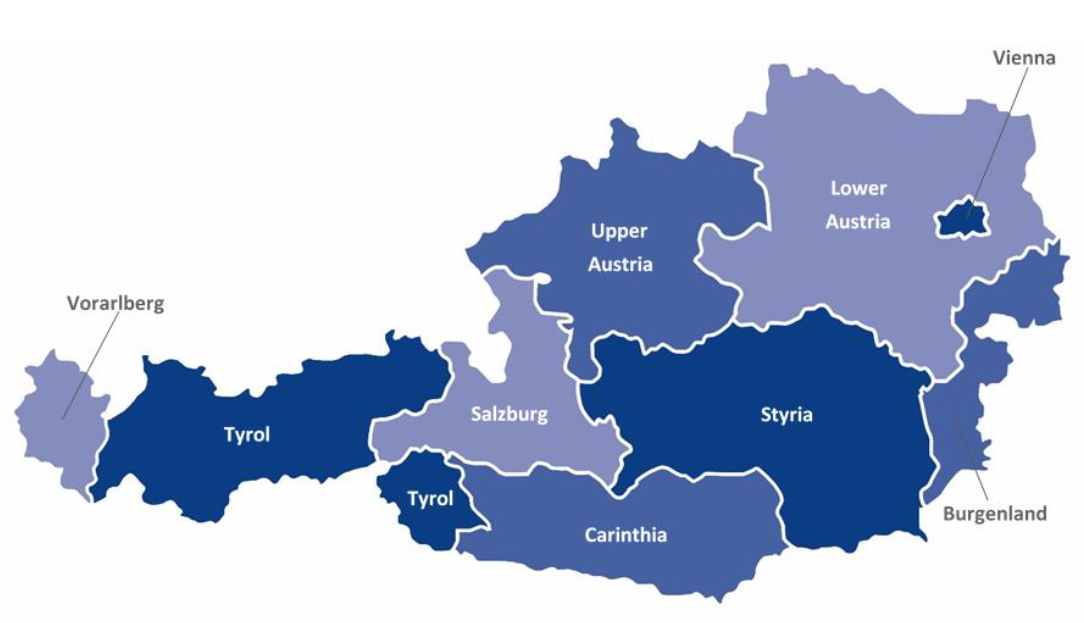
In Austria, responsibility for adopting and enacting specific tourism legislation lies with the nine federal states. As a result, Austria has nine separate tourism laws, with each federal state developing and implementing its own tourism strategy, including marketing and funding.
Tourism laws may include:
- Territorial structuring: classification of municipalities as tourism destinations and establishment of tourism regions.
- Organisation and administration: governance structures and associations.
- Financing: tourism related fees, taxes, and funding mechanisms.
Moreover, the federal states are also the competent regulatory authorities for several other areas relevant to tourism, including nature protection, regional planning, building regulations, and infrastructure development (e.g. regional road networks).
History
In 1911, Tyrol became the first Austrian federal state to enact a tourism law. It is considered the world’s oldest tourism law and forms the basis of the tourism organisation and administration that exists in Austria´s federal states today. The law focused primarily on the establishment of statutory tourism associations and funding mechanisms through compulsory contribution from businesses.